
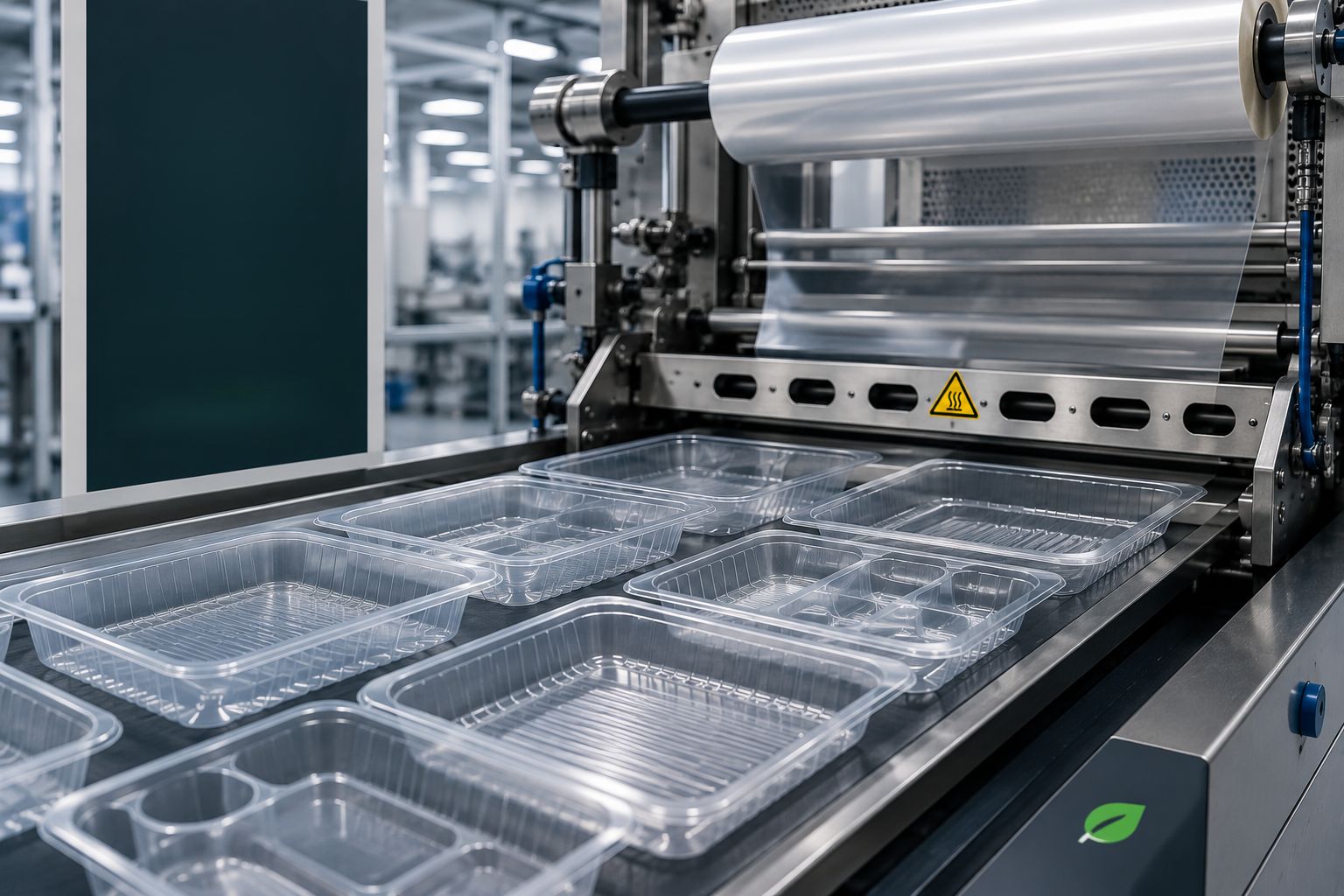
Thermoforming: an efficient solution for high-performance packaging
Thermoforming makes it possible to create precise, consistent packaging adapted to each product, combining protection, presentation and operational efficiency.
Thermoforming is one of the most widely used processes in flexible and semi-rigid packaging, especially when a product requires protection, visual appeal and consistent production performance.
Its main advantage lies in its ability to form cavities or trays from a plastic sheet, adapting to the product’s geometry and the specific needs of each production line.
How does thermoforming work?
In simple terms, the process consists of:
- Heating a plastic film or sheet until it becomes suitable for forming.
- Shaping the material over a mold using vacuum, pressure or a combination of both.
- Creating the cavity where the product will later be placed.
- Sealing the package with a top film, depending on the application.
This system is widely used in sectors such as:
- Fresh food
- Meat products
- Dairy
- Ready-to-eat products
- Pharmaceuticals
- Medical devices
- Consumer goods
Its versatility allows the development of solutions ranging from simple protective packaging to more complex systems with modified atmosphere, high-barrier structures or specialized seals.
Advantages of thermoforming in production
One of the reasons thermoforming is so valuable is its ability to maintain consistency across high-volume production.
When the package is properly designed, each cavity maintains stable dimensions, making the following processes more efficient:
- Filling
- Sealing
- Handling
- Final product presentation
This helps reduce line variations, improve operational performance and minimize waste caused by packaging failures.
Better use of space
Thermoforming also improves space efficiency. By adapting to the product, the package can:
- Reduce unnecessary volume
- Improve arrangement during transportation and storage
- Contribute to a cleaner shelf presentation
- Protect delicate products without compromising their integrity
This precision is especially important when the package must provide support, stability and protection throughout the distribution chain.
Compatibility with different materials
Another relevant advantage is the compatibility of thermoforming with different material structures.
Depending on the product’s needs, films can be selected for:
- Oxygen barrier
- Mechanical resistance
- Transparency
- Rigidity
- Flexibility
- Specific sealing properties
This allows the package to function not only as a container, but as an active part of product preservation, protection and commercialization.
Applications of thermoforming
In food applications, thermoforming can be combined with vacuum or modified atmosphere systems to help preserve:
- Freshness
- Appearance
- Shelf life
- Product stability
In medical or pharmaceutical products, it can be used to:
- Protect sensitive components
- Keep items organized
- Support identification
- Improve packaging safety
In consumer goods, it contributes to a cleaner, more structured and attractive presentation.
Factors to consider
For thermoformed packaging to perform properly, selecting a material is not enough.
It is necessary to consider:
- Product type
- Dimensions
- Weight
- Sensitivity
- Storage conditions
- Temperature
- Line speed
- Sealing method
- Distribution requirements
Poor design can lead to problems such as:
- Deformation
- Inconsistent seals
- Excess material
- Difficulties during filling
- Line failures
A technical solution, not just an aesthetic one
Developing a thermoformed packaging solution should be treated as a technical process.
Material selection, cavity design, machine compatibility and packaging behavior during operation must be evaluated together.
When these elements are properly aligned, the result is a package that is more:
- Stable
- Efficient
- Competitive
- Functional
- Adapted to the client’s production process
Thermoforming at Bioflex
At Bioflex, thermoforming is approached from an integrated perspective: not only as a way to contain products, but as a solution designed to meet the demands of each industry.
The goal is to create packaging that:
- Performs correctly on the production line
- Protects the product
- Strengthens its presentation
- Helps optimize processes
- Adapts to real production needs
Thermoforming is, in essence, a technology that combines precision, productivity and adaptability.
For companies looking to improve their packaging processes, it represents a strong alternative for developing more efficient, consistent and production-ready solutions.